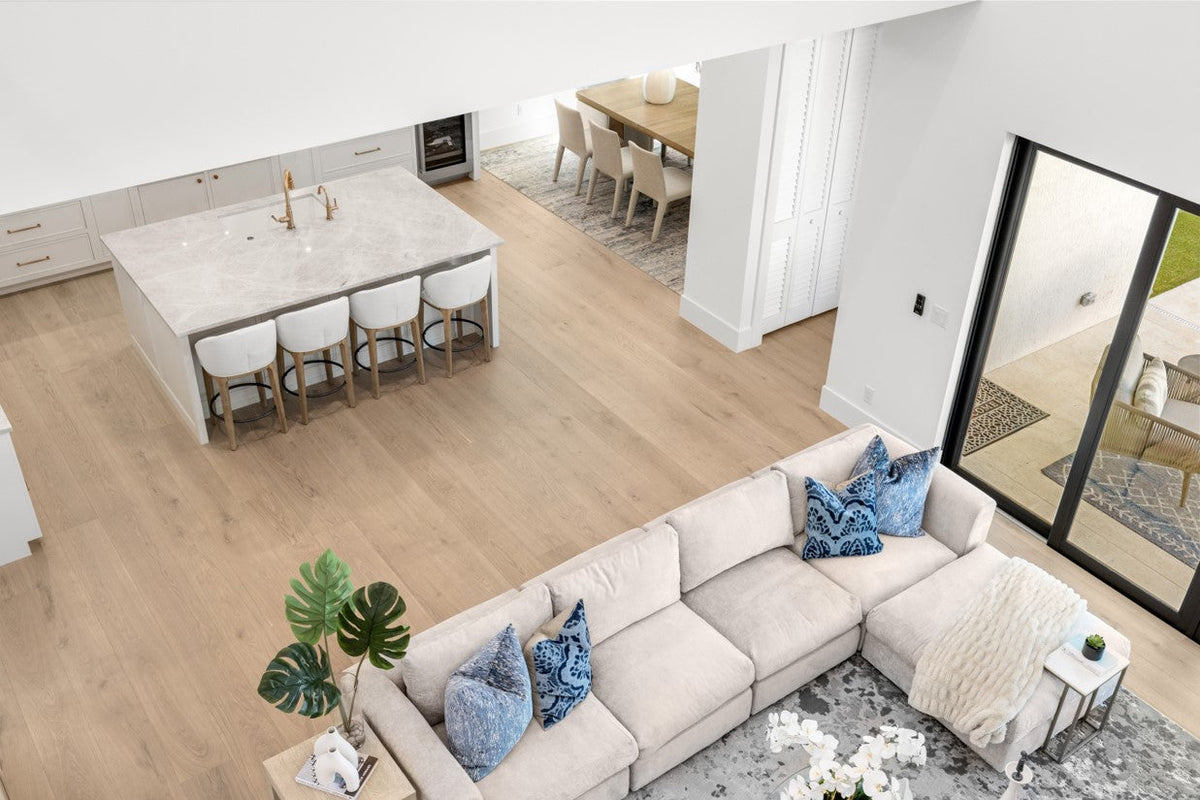
If you've spent any time looking at hardwood floors, you've probably run into the same question everyone does: solid hardwood or engineered hardwood? It sounds like it should be simple, but the deeper you dig, the more conflicting advice you find. Some people swear by solid. Others say engineered is the smarter buy. The flooring industry doesn't make it easy, either — there's a lot of jargon and not a lot of straight talk.
So here's the honest answer: neither one is universally better. It depends on your home, your climate, your budget, and how you live. Let's walk through the real differences so you can make a confident decision without second-guessing yourself.
The Basics: What's Actually Different?
Solid hardwood is exactly what it sounds like — a single plank of wood, top to bottom. If you cut it in half, you'd see the same species all the way through. It's typically 3/4 inch thick and gets nailed or stapled to a plywood subfloor.
Engineered hardwood is a real wood top layer (called the wear layer) bonded to multiple layers of plywood or high-density fiberboard underneath. Think of it like plywood with a beautiful hardwood veneer on top — except that "veneer" can be anywhere from 1mm to 6mm of genuine hardwood. The cross-layered construction is what gives engineered its dimensional stability.
Here's the thing people get wrong: engineered hardwood is not fake wood. It's not laminate. It's not vinyl with a wood-print pattern. The surface you walk on, touch, and see is real hardwood. The difference is what's underneath it.
Stability and Climate: This Is Where It Gets Real
Wood moves. It expands when it's humid and contracts when it's dry. This is just what wood does, and no finish or sealant stops it entirely. The question is how much it moves, and whether your home can handle it.
Solid hardwood moves more. In a home with consistent humidity (roughly 35-55% year-round), it'll be fine. But if your indoor humidity swings significantly — say, bone-dry in winter and muggy in summer — solid planks can gap, cup, or buckle over time.
Engineered hardwood handles humidity swings much better. Those cross-layered plywood cores counteract the wood's natural movement. Each layer expands in a different direction, so they essentially cancel each other out. This is why engineered is the go-to for basements, concrete slabs, and homes with radiant heat.
For Bay Area homes specifically: Our climate is milder than most of the country, but it varies more than people realize. If you're near the coast — San Francisco, Pacifica, Half Moon Bay — humidity tends to be higher and more consistent. Inland areas like Walnut Creek, Pleasanton, and Livermore can be surprisingly dry, especially in summer. And many older Bay Area homes sit on concrete slabs, which rules out nail-down solid hardwood entirely. If that's your situation, engineered is likely the better fit.
Installation: What Goes Where
Solid hardwood has one installation method: nail or staple it to a plywood subfloor. You can't glue it to concrete. You can't float it. This means if your home has a concrete slab on the first floor (common in Bay Area ranch-style homes), solid hardwood isn't an option unless you build a plywood subfloor on top — which adds cost, reduces ceiling height, and creates transitions at doorways.
Engineered hardwood is more flexible. You can nail it down, glue it directly to concrete, or install it as a floating floor with a click-lock system. That versatility means it works in more situations — over concrete, over radiant heat, in basements, and even in some multi-story condos where floating floors are required by HOA rules.
If you're doing the work yourself, floating engineered floors are the most DIY-friendly option. Click-lock installation doesn't require specialty tools or much experience. Nail-down and glue-down installations — whether solid or engineered — are best left to a professional.
Refinishing: The Long Game
This is where solid hardwood has a real advantage. A 3/4-inch solid plank can be sanded and refinished multiple times over its lifetime — realistically 3-5 times before you're too close to the tongue-and-groove profile. That means if your floors get scratched up in 15 years, you can sand them back to fresh wood and apply a new finish. It's like getting brand new floors without the cost or waste of a full replacement.
Engineered hardwood can be refinished too, but it depends entirely on the wear layer thickness. A floor with a 4mm or thicker wear layer can typically handle 1-2 sandings. Thinner wear layers (1-2mm) can't be sanded at all — you can screen and recoat the finish, but you can't take it down to bare wood.
Here's the practical reality, though: most homeowners never refinish their floors. The average American moves every 8-12 years, and modern finishes last 15-25 years with normal wear. So while refinishing potential is a genuine advantage of solid hardwood, it's not as critical as the industry makes it sound — unless you're in a forever home and planning decades ahead.
The Cost Conversation
If you're comparing entry-level to entry-level, solid hardwood is often slightly cheaper per square foot for the material itself. But total installed cost tells a different story.
Solid hardwood has higher installation costs (nail-down is more labor-intensive), and if you need subfloor prep — moisture barriers, plywood overlay on concrete — those costs add up fast. You also need to acclimate solid hardwood on-site for 3-7 days before installation, which adds to the project timeline.
Engineered hardwood materials can range from very affordable to extremely premium. A quality engineered floor with a 4mm+ European oak wear layer can cost as much or more than solid. But installation costs tend to be lower, especially for floating installations, and less subfloor prep is typically required.
Our honest advice: don't pick a floor type based on price alone. Pick the one that's right for your home's conditions, and then find the best product within your budget. A $4/sqft engineered floor that's right for your slab-on-grade home will outperform a $6/sqft solid floor that's fighting your concrete subfloor.
Appearance and Feel
This one is close to a tie. Premium engineered floors are visually indistinguishable from solid hardwood once they're installed. The wood species, grain, finish, and color are identical — because the surface IS the same real wood. Nobody is going to walk into your home and say "oh, that's engineered."
Where some people notice a difference is underfoot. Solid hardwood on plywood has a very slight give that feels warm and natural. Engineered hardwood glued to concrete feels firmer. Floating engineered floors can occasionally have a faint hollow sound when you walk on them, though a quality underlayment mostly eliminates this.
In terms of species and style options, you'll actually find more variety in engineered. European oak in wide planks (7"+), wire-brushed textures, and matte finishes — the looks that are most popular right now — are almost exclusively engineered. Solid hardwood in those wide widths is difficult to produce and more prone to movement issues.
So Which One Should You Choose?
Solid hardwood makes sense if:
- Your home has plywood subfloors (not concrete)
- Your indoor humidity stays relatively consistent
- You want maximum refinishing potential for a forever home
- You're installing on the main level or upper floors (not basements)
Engineered hardwood makes sense if:
- Your home sits on a concrete slab
- You want to install over radiant heat
- You're looking at wide-plank styles (7" or wider)
- You want more installation flexibility
- You're finishing a basement
- Your condo HOA requires floating installation
For most Bay Area homes, engineered hardwood is the more practical choice. Between the prevalence of concrete slabs, the climate variation from coast to inland, and the design trend toward wide European oak, engineered covers more situations with fewer compromises. That said, if your home has the right conditions for solid, it's a beautiful product with unmatched longevity.
What to Look for When Shopping
Regardless of which type you choose, here's what separates a good floor from a great one:
- Wear layer thickness (engineered): 3mm minimum. 4mm+ if you want refinishing options down the road. Anything under 2mm is disposable flooring.
- Total thickness: 5/8" to 3/4" for engineered gives you a solid, substantial feel. Thin engineered floors (3/8") can feel flimsy.
- Core construction: Baltic birch or European birch plywood cores are the gold standard for engineered. HDF cores are cheaper but less stable.
- Finish: UV-cured aluminum oxide finishes are the most durable. Look for 7+ coats. Oil finishes look incredible but require more maintenance.
- Milling quality: Run your hand along the edge of a sample. Tight tolerances mean cleaner seams once installed. Cheap floors have visible gaps between planks.
See It in Person
Photos and specs only tell you so much. Flooring is one of those purchases where you really need to see and feel the product before committing. The grain, the texture, the way light catches the finish — it all matters, and it all looks different in person than it does on a screen.
If you're in the Bay Area, you're welcome to visit our showroom in Lafayette to see our hardwood and engineered collections up close. Bring your paint chips, your cabinet samples, whatever helps you visualize. And if you'd rather start online, our Hardwood Flooring collection has detailed specs and lifestyle photography for every product we carry.
Need help figuring out how much you need? Every product page has a built-in coverage calculator — just enter your room dimensions and it does the math for you, including the 10% overage for cuts and waste.
And if you've already found the floor you love and want professional installation, you can request a free installation quote right from the product page. Our installation team at Abode Lafayette will put together a complete materials + installation estimate for your project.
Whatever you choose — solid or engineered — the right floor transforms a home. Take your time, do the research, and don't let anyone pressure you into a decision before you're ready.
Have a specific question we didn't cover? Get in touch — we're happy to help.